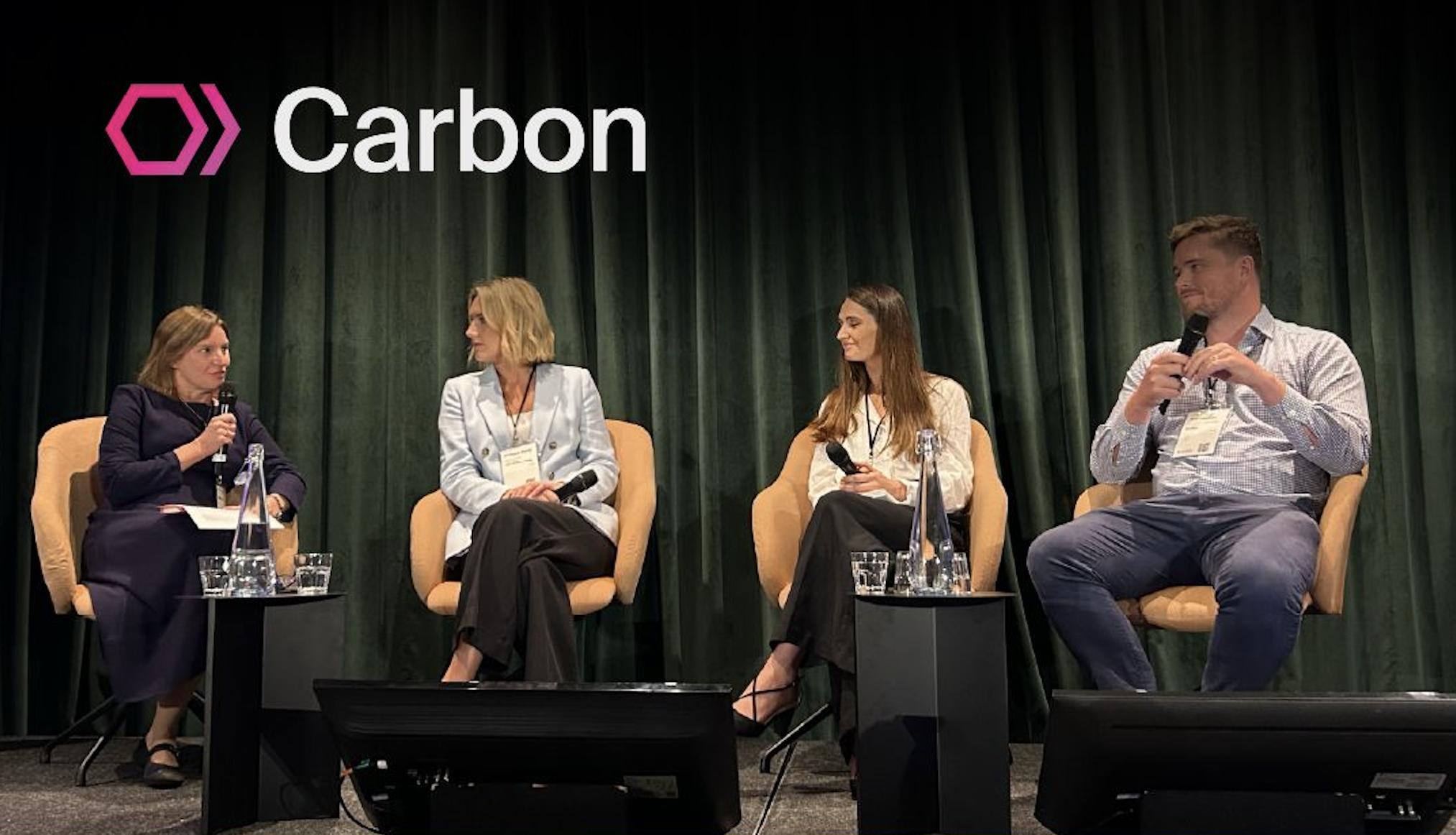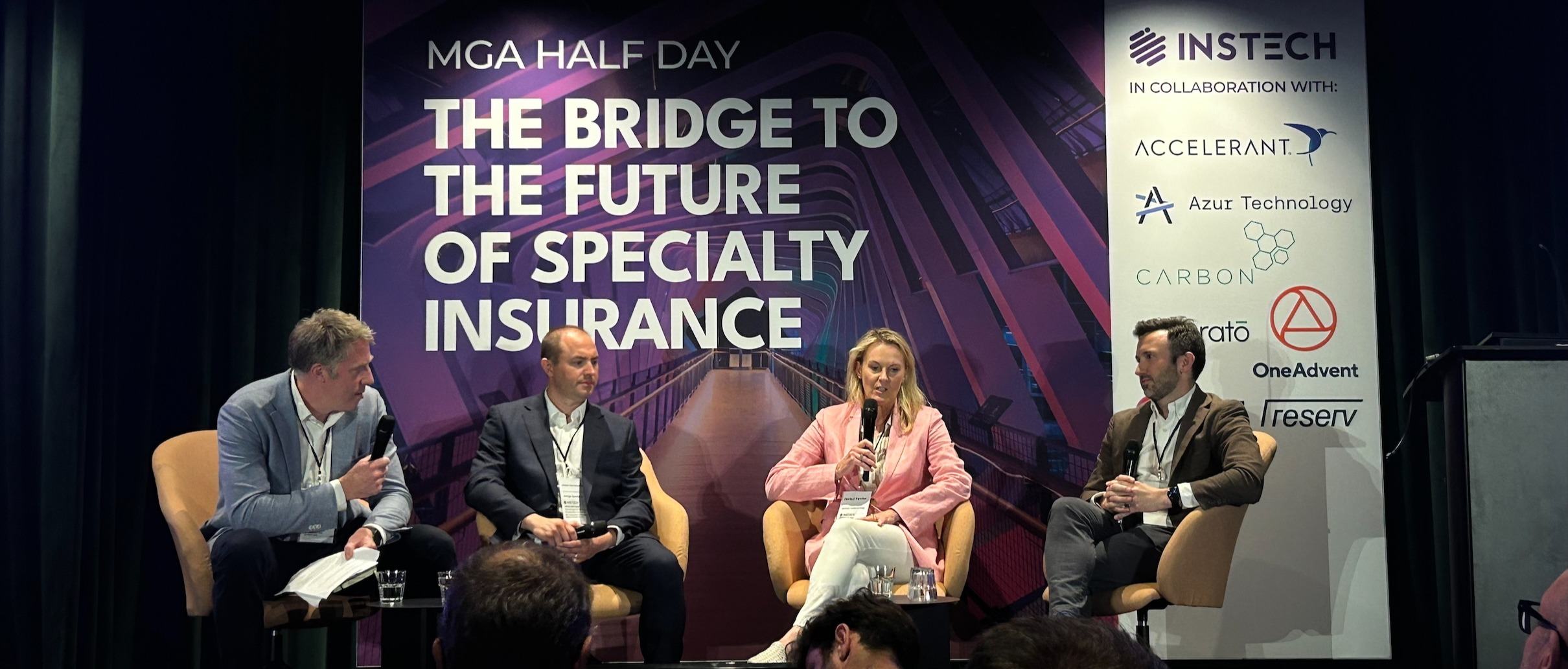
Insights from the Instech panel "The golden age of MGAs" with Becky Ince (Carbon, moderator), Philippa Berry (CFC), Jane Fenton (Gallagher Re) and Ben Laidlaw (Carbon)
The capabilities and perceptions of MGAs have come a long way according to Instech’s “The golden age of MGAs? Building to win any market cycle” panel. The old notion of MGAs as small operations restricted to niche spaces has given way to recognition of the value they bring. Investors are taking notice. Several syndicates are now publicly listed, and more MGA-related businesses are weighing a move to the public markets.
The panel agreed that this visibility could mark the start of a growth period, not the peak. But softening market conditions put the model to the test.
As Philippa Berry put it,
“You’re constantly having to innovate, move, challenge, progress to make sure you demonstrate to capacity providers what you can do that they can’t do it themselves.”
That relies on demonstrable differentiation, a point supported by Jane Fenton: “cycle aside, being a resilient MGA is about how you differentiate yourself… no one is going to provide you [capacity] to deploy unless you can show something different.”
Prove value: be more than a facility
Fenton drew a clear contrast between specialist MGAs and broker facilities, saying:
“Facilities… place more emphasis on the efficiency of taking risk and getting access [to] capacity behind it.” Specialist MGAs, by contrast, build differentiated portfolios through underwriting expertise, distribution or territorial knowledge. Fenton noted, “That [differentiated portfolios] in itself will increase the ability of MGAs to win in this space.”
Deliver what carriers cannot access
Capacity providers want to see that contribution before they commit capital. CFC is a good example. It built its proposition around technology-enabled distribution, bringing business from around 4,800 global brokers, including smaller brokers outside traditional London market channels. As Berry put it, “That’s business our capacity providers can’t access.” That is what proving value looks like: delivering something capacity providers can’t get on their own.
Attract and keep capital
The first step to achieving capital resilience is diversification. That is not just product, territory and distribution routes; it is the diversification of the capital behind the capacity. Ben Laidlaw explained that Carbon combines its own Syndicate 4747 with consortium capacity and non-Lloyd’s structures. He said: “by having a broad mix of providers, we have the ability to make sure we can always provide our capacity down the chain to MGAs. So, that diversification of capital for us is absolutely key.”
Alignment unlocks investment
Alignment matters just as much. Carbon’s own underwriting participation shows it shares in the outcomes of the business it delegates. Laidlaw said that MGAs having alignment with elements of the underwriting they are providing “makes it exponentially easier to go and raise additional capital.”
Growth must still earn its place
That said, the panel also acknowledged that capacity providers and Lloyd’s remain wary of rapid growth and of delegation that only serves to add commission and acquisition costs to business a carrier could write directly. As Laidlaw outlined, Lloyd’s is now focusing on the portfolio as a whole “because there is a concern about delegating underwriting you could be doing yourselves.”
Data that tells a story
Laidlaw noted that most players in the market now claim to be data-driven:
“It’s like getting free Wi-Fi in a coffee shop, it’s expected now. The whole concept of an MGA being data-driven is implicit.” What sets an MGA apart is its interpretive capabilities: ensuring the data tells a story and explaining rate movement - in its own book and across the wider market - rather than producing numbers without context. The significance of contextual data was highlighted by Fenton: “It’s about how you demonstrate profitability of your book. You need to be able to demonstrate performance characteristics, identify trends in your portfolio, identify rate change, and be able to communicate that to your capacity provider.”
Turn transparency into trust
Greater transparency builds trust and supports capacity commitments. Berry stressed that data should add value for the insured too: “You have to make sure what you’re providing down to the insured adds value. How can we leverage that data to add value? How can we identify trends to let our insureds know what they need to look for?”
CFC, for example, analyses threat actors and their tactics, then turns the findings into guidance that helps its SME customers understand which risks to monitor. In this way MGAs can demonstrate value across all relationships with partners, not just capacity providers and carriers.
AI is only as strong as the data
AI raises the stakes on all of this. Firms are already using it to help with data ingestion, enrichment and analysis, speeding up the work MGAs do to demonstrate underwriting performance. But those gains only go as far as the quality of the underlying data allows.
Offer sustainable growth in a softening market
In a softening market, the focus should shift from rates to sustainable growth. Fenton highlighted that point, saying: “It’s about how are you securing sustainable growth over the long term through the market cycle. MGAs have this ability to identify specific niches and pockets.”
Improve the programme, not just the price
At capacity programme renewal, the emphasis should be on improving programmes, optimising capacity panels and structures, and reducing volatility, rather than leaning on rate cuts. These are longer-term answers to the cycle, designed for sustainability.
Find growth beyond the obvious markets
MGAs continue to offer access to under-tapped markets and niche geographies. As a result they can maintain attractiveness even in a soft market, as they can provide a sustainable growth outlet for carriers.
Making the golden age last
In a softening market, the MGAs that thrive will be those that clearly demonstrate their value, make their data work for them and their partners, diversify their capital, and maintain alignment with the people backing them. Doing that before margins come under pressure is what will turn the current golden age for MGAs into a lasting period of success.